
Thirty-six percent of adults get that stomach-drop feeling just thinking about a dentist's chair. I used to find that number weirdly comforting, having company in my misery, until I noticed how many of us handle dental anxiety the exact same backwards way: treating gum health like something you scrub into submission, ignoring the oral microbiome completely, and calling the whole mess a home care routine.
Quick disclosure before we go further — a couple of the links below are affiliate links, including one for ProvaDent, a gum-support product I actually use. If you buy through them, I earn a small commission at no extra cost to you. I'm not a dentist or any kind of medical professional, just someone who has spent years testing every product and trick to avoid the chair, so check with your own dentist before changing anything about your own routine.
Here's the misconception I bought into for years: that gripping the toothbrush tighter and flossing with enough force could out-muscle my own gums into looking healthy. I learned otherwise the hard way. A traumatic filling at eight is where all of this started for me, and avoiding the chair through most of my twenties eventually cost me two root canals I still think about more than I'd like to (nothing motivates flossing quite like paying off a root canal). Eight years into managing this fear from home instead of a waiting room, I've picked up a few things, mostly by getting them wrong first.
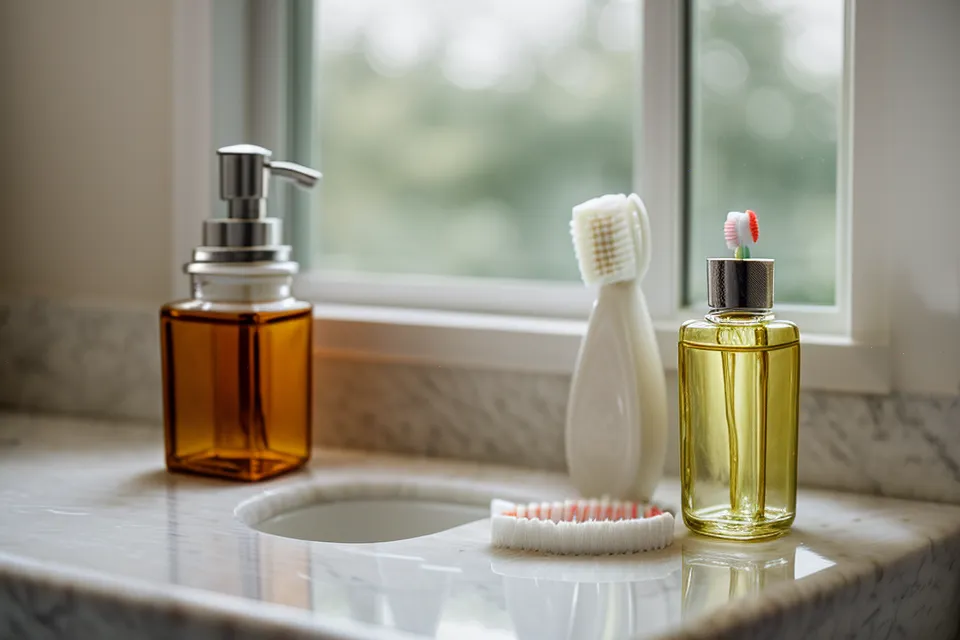
My bathroom in Capitol Hill is not exactly Pinterest material. A window ledge crowded with brown glass bottles I've never quite finished, a little lineup of toothpaste tubes in different stages of half-squeezed because committing to just one feels impossible, an overhead bulb that stutters faintly whenever the building's heat clicks on. There's a specific sound in there too: a toothpaste cap landing on tile, too early some mornings, before my brain is even fully online. It still makes something in my chest tighten a little, even on calm days. This is where the fortress gets built, every single morning.
The Gum-Health Myth That Keeps Anxious Mouths Scrubbing Harder
The myth goes like this: if your gums are reacting, the fix is being more aggressive, not less. I tried both ends of that. Whitening strips wrecked me for the better part of a week once. The kind of sensitivity that made anything above room temperature feel like a small betrayal made me swear off anything with a heavy ingredient list after that. Then I swung the other way and started flossing like I had something to prove, which turned out to be exactly backwards. I was already following the anxiety-proof routine I'd built over years of trial and error, and even that wasn't calming the tight, inflamed feeling along my gumline.
Pressure doesn't make gums stronger. It makes them angrier, leaving them tender at the gumline, which makes you want to floss harder, which is the actual trap. It's the same instinct that makes people re-check a locked door three times or reread the same text message before hitting send. More effort feels like control, even when the effort itself is the problem. Brushing pressure and technique matter more than most people realize, though that's a deeper subject than I can do justice to in one post. What calmed things down for me wasn't more force. It was backing off the friction and giving my mouth's own defenses something to work with instead.
The Problem Isn't How Hard You're Trying
There's a whole ecosystem living in your mouth. Most of it quietly does its job, a little of it causes trouble. You can read more about oral microbiology than I ever planned to if you go down that particular rabbit hole. I'm not going to pretend I understand the science at a clinical level. What I noticed, in my own unscientific way, is that scrubbing at my gingiva like it was a stain on a countertop wasn't protecting it. It was wearing it down.
These days, my tongue finds the back of my bottom teeth smooth most afternoons instead of catching on that fuzzy film that used to show up well before lunch. That's not a dramatic before-and-after. It's just what happens when you stop treating your mouth like something to scour and start treating it like something to support.
Where ProvaDent Fits Into the Correction
This is the part where I mention the actual product, because pretending I don't use one would be dishonest. I started taking ProvaDent once I accepted that my old approach was the problem, not a lack of effort. It's built around supporting that same ecosystem rather than fighting it, and it slotted into my existing routine without adding another aggressive step to a mouth that had already had enough aggression for one lifetime.
I also looked hard at ProDentim before settling on ProvaDent. It's a reasonable option in the same category, and I don't think there's one single right answer here. I picked ProvaDent because it matched what I specifically wanted: gum support, nothing flashy, nothing that asked me to overhaul my whole cabinet overnight.
A reader named Wren once emailed me the kind of question I respect: not "does this work" but exactly which ingredients to check before trying anything new. Fair ask. My honest answer: there's no single ingredient that makes the decision for you. What matters more is whether your gums feel less reactive a few days after you start something new, not more. If flossing afterward still makes you wince the same as before, that's your sign to stop and reassess, not push through it.
Building a Gentler Routine Instead of a Tighter Grip
My actual day-to-day didn't change as dramatically as I expected once I stopped treating force as the goal. I still follow a version of the routine I'd put together over the years, and I switched to an alcohol-free mouthwash a while back because the sting of the regular stuff had become its own small trigger. None of this required throwing out everything I owned. It required admitting that harder wasn't working.
Quincy still laughs at me a little when I start spiraling about a tooth that's probably fine. Not unkindly, just enough to talk me down from the ledge before I convince myself I need an emergency appointment over nothing. I need that. Dental anxiety left unchecked will absolutely convince you that a normal twinge is a four-alarm emergency, and it helps to have someone around who doesn't take the bait.
If you're stuck in the scrub-and-panic loop I used to live in, the fix probably isn't trying harder at the thing that isn't working. It's easing up and giving your mouth something to work with instead of something to fight. You can check ProvaDent's current pricing on their official page if you want to see where it fits into your own routine. It shifts occasionally, so that's the only place I'd trust for an exact number. This isn't a problem I've solved for good, and I don't think dental anxiety works that way. It's just quieter now than it used to be, most days.